Data, discovery and curiosity: three reflections from The MarTech Summit London
Sarah Heming
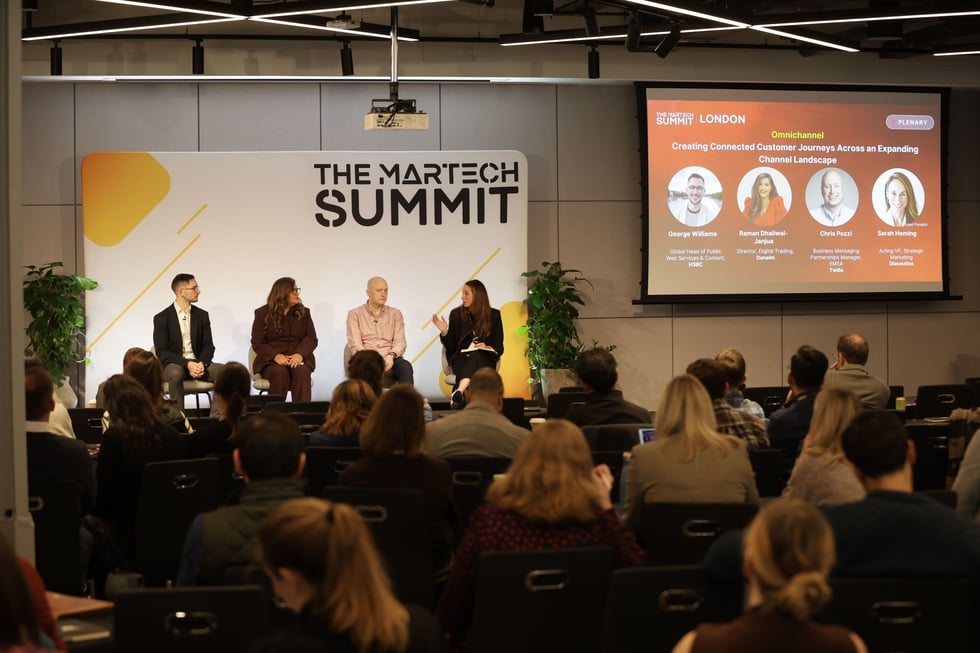
Sarah Heming, Interim VP of Strategic Marketing at Diaceutics, joined industry leaders at The MarTech Summit London, where she moderated a panel discussion on omnichannel marketing and what it really takes to create connected customer experiences. Across two days, the programme explored connected intelligence, AI and authenticity, customer data, agentic marketing, organizational transformation, marketing and sales alignment, personalization and the future of content. AI was therefore more than a standalone topic. It ran through almost every conversation about how marketing is changing.
But when I stepped back afterwards, what stayed with me wasn't really the technology.
It was the human questions underneath it.
How do we use increasingly sophisticated data to understand what somebody actually needs? What happens when AI doesn't just help us search for information, but starts interpreting brands for us? And as technology makes it easier to arrive at answers, how do we make sure we don't lose the curiosity that leads us to ask better questions? Read Sarah’s key takeaways from the Summit:
1. What someone actually needs: data shows you, people decide
One of the recurring themes for me was the opportunity to use data and technology to create more genuinely connected customer experiences.
We have access to more data, signals and intelligence than ever before. AI gives us increasingly sophisticated ways to connect those signals, recognize patterns and understand behavior.
That is incredibly powerful.
But having more data doesn't automatically mean understanding somebody better.
There is an important distinction between insight and judgement.
Data can show us what is happening. AI can help us recognize patterns at a scale and speed that would previously have been impossible. But understanding why those signals matter, what somebody genuinely needs and how we should respond still requires context, judgement and empathy.
The omnichannel challenge adds another dimension. Customer journeys now unfold across an expanding landscape of digital and human touchpoints. A connected experience therefore isn't achieved simply by adding another channel. It requires organizations to connect data and decisions across those channels so that each interaction is informed by the wider customer journey.
That feels particularly relevant to healthcare, where the journey can be complex, fragmented and influenced by multiple stakeholders and decision points. Healthcare professionals, laboratories, health systems, pharmaceutical companies and patients may each hold a different part of the picture.
The answer isn't simply more personalization. It's using intelligence to understand what matters at that particular moment, and then applying human expertise to determine what should happen next.
Data shows us. Technology helps us understand. People decide.
2. Owning the second layer of AI search: being found is no longer enough
Another session I found fascinating was The Next Evolution of AEO: Owning the Second Layer of AI Search. It explored how large language models are not simply retrieving information about brands. They are interpreting, supplementing and forming opinions about that information.
For years, marketers have largely thought about search in terms of discoverability: when somebody looks for something relevant to us, can they find us?
AI introduces a second layer.
Increasingly, people aren't simply receiving a list of sources and deciding what to explore. An AI platform can interpret those sources, connect information and synthesize an answer before the person ever visits the brand's website.
The “Parrot Problem”: a brand may appear in an AI response, but the model can repeat incorrect or outdated information, introduce competitor recommendations or add editorial commentary that the user did not request. In one example, an airline appeared in a relevant answer but was accompanied by outdated information. In another, an answer about a specific running shoe proactively suggested competing products.
The scale of this editorial layer was striking. The research analyzed 50,000 LLM responses across seven industries and five main prompt types. It found that approximately 47% of response content was unsolicited, demonstrating that AI answers frequently extend well beyond a direct response to the original question.
So we need to start asking a different question:
When AI interprets our market, does it properly understand who we are, what we do and why our expertise matters?
Being visible is one thing. Being understood and represented accurately is another.
Research found that 50% of the most-cited content was less than 13 weeks old, reinforcing the importance of publishing information that is not only credible but also current. It recommended creating first-party content that is structured, quantified and unambiguous, alongside more specific information that AI systems can extract and use accurately.
This isn't solely an SEO responsibility. The proposed model brings together SEO and answer-engine optimization, content marketing, social media, growth marketing, PR, corporate communications and product marketing. The goal is to build an authoritative and consistent ecosystem of information around the brand.
For me, this reinforces the importance of the intelligence behind our content.
Simply telling people we're “best in class” isn't enough. Brands need depth, evidence, genuine expertise and a clear and consistent point of view. Claims need to be supported by content that explains what a business does, how it does it and why that difference matters.
In healthcare in particular, where evidence, accuracy, credibility and nuance are essential, that is significant. It means treating accuracy, source authority and message consistency as part of how we manage our presence in an AI-mediated world.
The next generation of search may not simply be about being found. It may be about being understood.
3. Curiosity may be one of our most important capabilities in an AI world
This was perhaps the theme that connected everything for me.
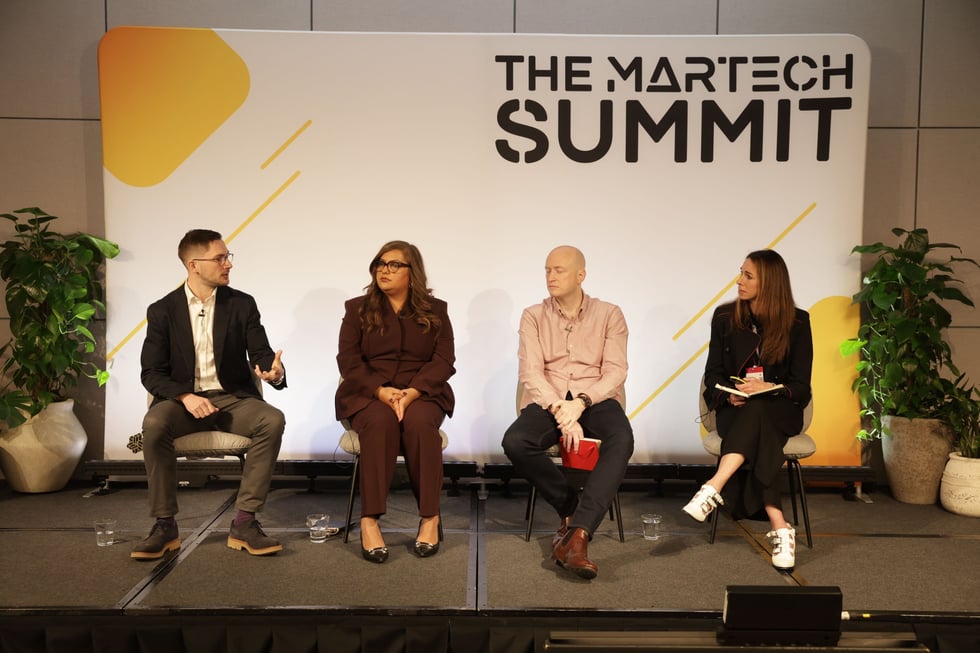
During the panel I moderated, we talked about what it takes to create a culture where experimentation can genuinely thrive.
Not simply running an occasional test, but giving people the confidence and psychological safety to experiment, challenge assumptions, try different approaches, learn quickly and adapt. It means moving towards a genuine rhythm of test, learn, adapt and repeat, rather than treating experimentation as a standalone marketing activity.
This matters because AI is already changing how businesses engage with customers. We discussed examples of companies experimenting with AI agents to manage everyday purchasing decisions, creating the prospect of bots interacting with other bots to fulfil a customer's needs.
That could fundamentally change parts of the customer journey. In some situations, marketers may no longer be communicating only with a person. They may also need to provide information that an AI agent can find, interpret and act upon on that person's behalf.
At the same time, we need to avoid allowing AI to become a shortcut around curiosity.
The Future of Content: Why Brands Still Need Humans panel posed several important questions: Is AI making marketing faster while also making it less thoughtful? Are we automating away our ability to think? And what happens to competitive advantage when every brand has access to the same intelligence?
Those questions resonated with me.
LLMs can help us reach an answer extraordinarily quickly. But the fastest answer isn't necessarily the most interesting one, and it isn't necessarily the best one.
If every organization uses similar models, responding to similar prompts and drawing from the same publicly available material, speed and access to technology alone will not create lasting differentiation.
Our advantage will increasingly come from people who are curious enough to ask the next question, interrogate an output, challenge an assumption, introduce original evidence and bring different perspectives together. It will come from people prepared to experiment with an approach that hasn't already been presented to them.
That's also why I was fascinated by the conversation around the emerging role of the marketing engineer.
This role brings together marketing understanding, data, technology and the practical ability to build and experiment with new solutions. It reflects how our profession is evolving from simply operating established channels and platforms towards designing connected systems, testing new workflows and translating rapidly changing technology into useful customer and commercial outcomes.
AI should give us greater capacity to do those things, rather than taking away the need to do them.
What connects all three? People.
The technology available to marketers will continue to evolve incredibly quickly.
Better data can help us understand more. AI will reshape how information is discovered, interpreted and acted upon. New tools will allow us to test and execute ideas that would previously have taken considerably more time and resource.
But technology alone isn't the differentiator.
We can invest in all the technology in the world, but it's our curiosity, judgement, willingness to experiment and ability to keep learning that will determine what we do with it.
The most effective marketers will not simply adopt new technology. They will connect data with human context, build evidence-rich content that both people and AI systems can understand, and create cultures in which teams have the confidence to question, test and improve.
Perhaps our biggest opportunity isn't simply to become better at using AI.
It's to remain curious enough to keep asking what AI alone won't.
About Diaceutics
At Diaceutics we believe that every patient should get the opportunity to receive the right test and the right therapy to positively impact their disease outcome.
We provide the world's leading pharma and biotech companies with an end-to-end commercialisation solution for precision medicines through data analytics, scientific and advisory services enabled by our platform DXRX – The Diagnostics Network ®
FAQS
How is AI changing the future of marketing?
What role does human judgement play in AI-powered marketing?
How is AI changing search and brand discovery?
Why is curiosity important for marketers using AI?
Written By Sarah Heming


