From Targeting to Relevance: 4 Takeaways from Pharma Customer Engagement USA 2026
Diaceutics Team
Pharma has more data, more technology and more channels for HCP engagement than ever before. But more capability does not automatically mean more relevance.
At Pharma Customer Engagement USA 2026, discussions across HCP segmentation, customer orchestration, AI and field execution pointed to the same underlying problem: more information and more ways to activate it do not necessarily result in better HCP engagement.
Traditional HCP targeting models can show who prescribed in the past. But does that tell us who will influence the patient’s next treatment decision?
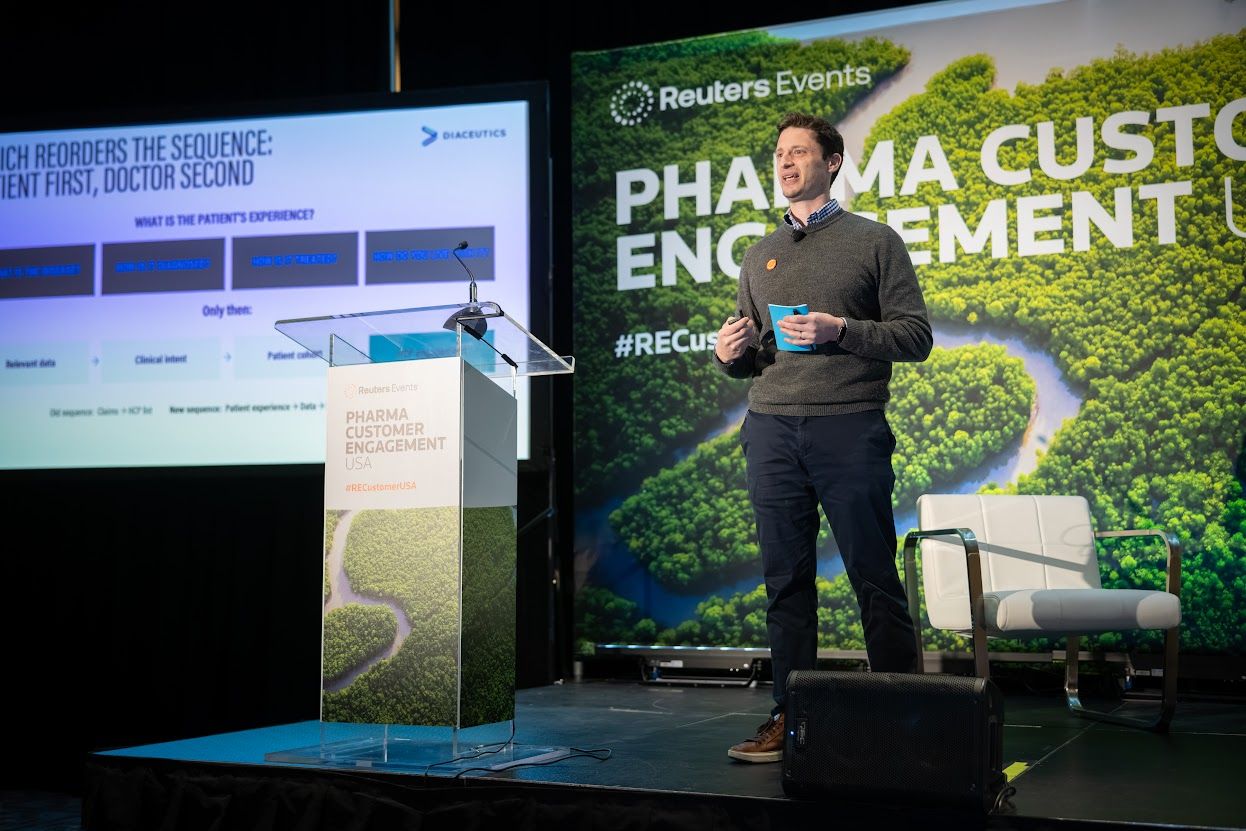
That question was central to Scott Phillips’ session, Patient First, Doctor Second: Rebuilding HCP Targeting Around the Patient Experience. Scott Phillips, VP of Real World Data at Diaceutics, challenged traditional claims-based targeting and explored how claims, lab, EMR and diagnostic signals can build a more complete picture of the HCPs influencing patient care.
“Just because it’s HCP targeting doesn’t mean the patient shouldn’t be at the center of what we’re doing.” - Scott Phillips, VP of Real World Data, Diaceutics
The patient-first challenge connects to a wider question that surfaced throughout the event: what actually makes HCP engagement relevant?
Here are four takeaways.
1. Start with the patient, not the target list
Traditional HCP targeting often starts with claims: identify historical activity, rank HCPs and build a target list.
But what if that means starting in the wrong place?
Claims can show what happened historically, but they do not necessarily provide a complete picture of what is happening clinically. A claim is a billing record. It tells us what was billed and by whom, but it does not tell us the full story of the patient’s care.
The HCP most visible in historical claims may not be the person influencing the patient’s next treatment decision.
Scott demonstrated how traditional targeting can overlook relevant HCPs. In one example from his presentation, 80% of prescriptions came from decile-zero doctors who had not previously been engaged.
The implication goes beyond improving the accuracy of a list.
The starting point itself needs to change.
Rather than beginning with Who prescribed?, commercial teams can start by asking: How does this patient get treated?
That means looking beyond the retrospective patient journey captured in claims and considering the wider patient experience: how the disease is diagnosed, which routes through care are available and which HCPs influence decisions at different points.
2. More signals don’t automatically mean more insight
Moving beyond claims does not mean simply adding more datasets. More data is not the same as better insight.
Claims, laboratory results, EMR data and diagnostic signals can each provide a different view of the patient experience. Together, they can provide more of the clinical picture than billing activity alone.
But a signal without context can only tell you so much. That is where clinical intent matters.
Scott Phillips described clinical intent as understanding the why behind a physician’s decision, rather than waiting until the decision has already happened before acting. Combined with richer clinical and diagnostic data, it can help build a more relevant view of the HCPs involved in the patient’s care. His framework covers diagnostic, referral, monitoring and treatment intent.
The same challenge applies to HCP segmentation: individual signals only become useful when they are interpreted in context.
In the session, ‘Decode HCP Signals: Smarter Segmentation for Relevant Engagement’, Akash Jain, Director, Data & Analytics Strategy, US Oncology at Merck, examined how observed HCP behaviors can be translated into actionable segments, distinguishing direct evidence from proxies and projections.
More signals do not automatically produce better insight. The better question is not:
How much data can we bring into our targeting? It is: Which signals help us understand what is happening with the patient and what may happen next?
3. Orchestration isn’t another technology project
AI, automation and omnichannel infrastructure featured heavily across Pharma Customer Engagement USA.
But technology is an enabler, not the starting point.
In the Keynote panel ‘The New Commercial Frontier: From Static Journeys to Dynamic Customer Orchestration’, Darshan Joshi of Takeda and Elizabeth Beringer of Real Chemistry looked beyond rigid CRM journeys towards orchestration that can respond to context, timing and intent.
But orchestration requires more than infrastructure. Data, content and channels need to work together across the customer experience.
And the customer journey cannot be separated from the patient journey. In From Prescription to Patient Journey, Saket Malhotra of BioMarin, Holly Valdiviez of Acadia Pharmaceuticals and Lauren Cole of Valeris discussed how data, technology and cross-functional working can connect commercial activity more closely to the patient journey.
Sophisticated technology cannot compensate for a poorly defined problem, weak inputs or an organization that cannot act on the output.
Scott Phillips’ presentation reached a similar conclusion from a diagnostic data perspective. Getting to a more relevant view of the patient is not simply about more data. It requires the right data, with the right context, expertise and question.
AI can accelerate analysis, identify patterns and help teams operate at scale. The presentation makes the distinction particularly clear: AI can accelerate the data-heavy parts of the process, while judgement remains necessary around the patient experience and who, when and why to engage.
The question is not simply how quickly pharma can execute.
Are teams accelerating the right strategy in the first place?
4. Insight only matters if teams can act on it
Better data and richer segmentation have limited value if the intelligence arrives too late or cannot be translated into action.
That was the focus of the panel ‘From Insight to Action: Empower Teams with Real-time Data Intelligence’, where Nadia Tantsyura from Bristol Myers Squibb and Philip Poulidis of ODAIA discussed moving beyond static reporting towards real-time intelligence that can help commercial and medical teams act faster.
That shift from insight to action matters for HCP engagement.
It is not enough to identify a signal. Teams need the context to understand it and the ability to act while the information is still relevant.
Act while treatment decisions are still forming
Signal identifies therapy-relevant diagnostic activity and treating HCPs in as little as 24 hours. Physician Engage, powered by Signal, turns that intelligence into targeted HCP engagement while treatment decisions are still forming.
The closing discussions at Pharma Customer Engagement USA reduced that principle even further: Data + context + time = action.
Insight that arrives after the opportunity has passed is still hindsight.
The HCP on the receiving end of that engagement may not be static either. Scott Phillips’ presentation showed how different healthcare professionals can move between the roles of treater, coordinator and influencer as a patient progresses from first signs through diagnosis, treatment decisions and ongoing care.
So the objective cannot simply be a better ranked HCP list. It is to understand the patient experience well enough to identify which HCP matters at that point, what is happening clinically and whether there is still an opportunity to engage.
From more engagement to more relevant engagement
More data, more channels and more technology do not create relevance on their own.
Relevant HCP engagement starts with understanding the patient experience, bringing the right clinical and diagnostic data into view and interpreting the clinical intent behind those signals. Only then can commercial teams identify which HCPs matter, when they matter and where engagement can add value.
The next frontier is relevance
Programmatic technology is making HCP targeting faster, more automated and increasingly precise.
The next challenge is ensuring that precision translates into relevance.
That means looking beyond whether an HCP can be reached and asking what the underlying clinical and diagnostic signals tell us about the patient journey, the decisions being made and the moments where engagement could matter most.
Because reaching the right HCP is only the beginning. Understanding why that HCP matters, for which patients and at what moment is where precision starts to become meaningful.
Turn diagnostic results into timely, targeted HCP engagement
Reach HCPs when it counts. Discover how Diaceutics can help you focus on the signals, audiences and decision points that matter across your engagement strategy.
FAQs
Why isn’t prescription data alone enough for effective HCP targeting?
How can clinical and diagnostic signals improve HCP targeting?
What does a patient-first approach to HCP targeting mean?
Why does timing matter in HCP engagement?
Written By Diaceutics Team


Newsletter sign up
READY TO DO COMMERCIALIZATION DIFFERENTLY?
You might also be interested in?
Amplifying Your Precision Medicine Strategy: The role of Engagement Experts and Peer Networks
Enhance your precision medicine strategy through multi-modal communications and peer engagement, driving effective diagnostic commercialization and maximizing patient outcomes.