Levelling Up Series Part 3: The Systemic Shadow Hanging Over the Value of Diagnostics
Peter Keeling
Our underlying premise in this trilogy of posts remains that more needs to be done to determine the value which better testing delivers to better treatment outcomes in precision medicine. Only then can we truly assess and apply value-based care.
You might assume that the value of diagnostics is already well articulated in precision medicine; after all the likelihood of a targeted drug being prescribed in the absence of a test is low (though not non existent). You would be wrong!
Table 1 below summarizes the result of an analysis carried out using PubMed to assess hundreds of papers in which you would expect the value of diagnostics to be determined and quantified in the discussion around better patient outcomes. Stunningly, only 32 of the assessed papers from this extensive expert search passed the test, and only 8 papers truly described the role of testing in directing treatment choices. Frankly, this is not good enough and leads us to believe that the reason diagnostics constantly struggle to articulate their value, and subsequently be reimbursed an amount which reflects their clinical value, is because there is an absence of proper measurement. The net result is a systemic shadow over the value of diagnostics which ensures testing will always be under- rewarded relative to other parts of the patient journey.
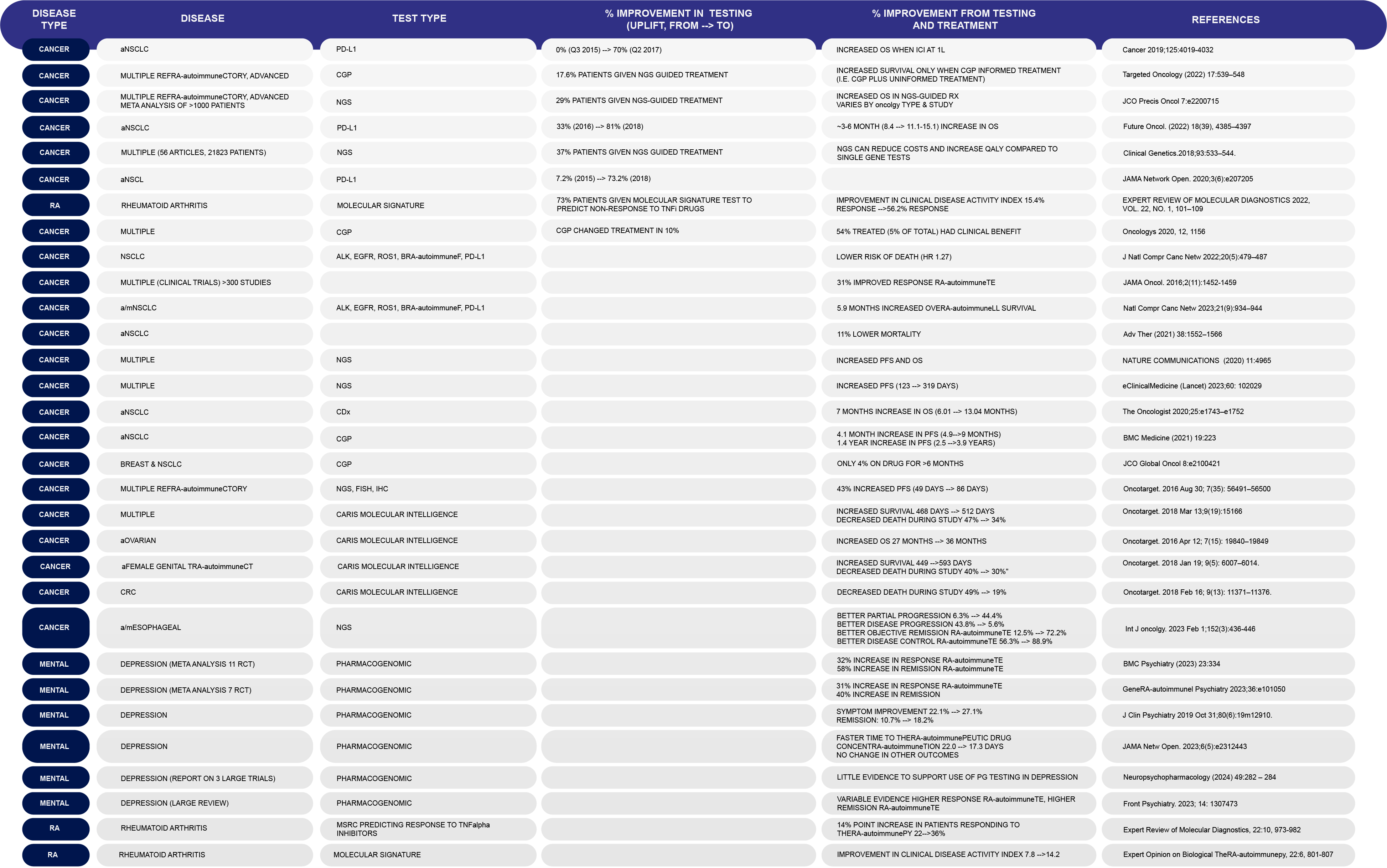
This needs to be rebalanced or levelled up. Our failure to do so is having critical consequences for precision medicine in 3 key areas addressed below:
The first is a loss of diagnostic innovation. Diagnostic companies have always struggled for funding, IP protection of novel technologies and value-based reimbursement. The failure rate of diagnostic companies in the US between 2014 -2017 was estimated to be a stunning four out of every five companies launched[i]. This has likely worsened in 2023, where a significant number of diagnostic companies have shuttered or struggled to show any growth. Interestingly, the costs to develop a new treatment invariably include the cost of failure, the costs to develop a new diagnostic do not. Adding to this challenge, in most cases new diagnostic assets, or even new technologies, will not have the benefit of patent protection leaving the diagnostic companies with a very small window of opportunity to earn back the development investment before competitors launch equivalent tests.
The second is that there is no consistent ability to challenge the value ascribed to better testing by payers, a topic many blame for insufficient reimbursement and the demise of diagnostic companies. Take the recent collapse in corporate value of Nasdaq-listed LumiraDx as a case in point, where the CEO of the British In Vitro Diagnostics Association stated:
“[Payers] put up a big smokescreen about why diagnostics aren’t used. During pilot studies, they really like them, and they want to use them. But when they have to start paying for it, that’s when they say there’s no funding[ii].”
True or not, payers are likely to point out that a lack of universal measurement and clear quantification of the specific value of testing in precision medicine hardly helps and it is unclear who should fund this work.
The third is that the economic ecosystem of precision testing is in disarray. Whilst diminished economics alone are not the only barrier to better testing, they are a primary one, and stealthily work against the levelling up of the role of testing in delivering its share of the significant clinical impact which precision medicine brings to patients and healthcare systems. Our own analysis of the clinical Practice Gaps published in 2022[iii] called out inadequate test reimbursement as one of the 7 gaps resulting in 66% of patients not getting tested the right way.
A recent article in Nature[iv] spoke to the consequences of under-appreciating the investment required to drive test adoption. The Nature article described the analysis of whole-genome sequencing (WGS)* data from 13,880 solid tumors spanning 33 cancer types, and integrated genomic data with real-world treatment and outcome data, within a secure research environment. This was a large-scale follow-on analysis of the 100,000 Genomes Project, an initiative to provide WGS for patients with cancer, within the UK National Healthcare Service (NHS).
The research pointed to the impact from better testing:
“Our findings demonstrate the utility of linking genomic and real-world clinical data to enable survival analysis to identify cancer genes that affect prognosis and advance our understanding of how cancer genomics impacts patient outcomes.”
However, it also highlighted a challenge in implementation:
“Yet, challenges remain in implementing clinical WGS in the NHS in England not least because of the overall cost compared to large gene panel testing. Providing a cutting-edge UK genomics service requires not only the sequencing and analytical infrastructure, but the consideration of operational requirements (such as improvements in tissue pathways and turnaround times to inform clinical decision-making) together with local pathway transformation and the development of knowledge and skills of the multiprofessional workforce supporting cancer care.”
An argument often put forward in precision medicine is that the pharma industry should intervene to fund a systematic adoption of gatekeeper tests, allowing patients the best options for relevant testing and thus enabling them to receive the treatment best suited to them. Pharma have shown their willingness to do this on occasion, but in reality there has been no meaningful debate on this concept and it is deployed therefore only as a last resort. This is a missed opportunity and we encourage an investigation and discussion between industry, payers and regulators to provide guidance and best practice direction.
As mentioned above, our analysis of papers where the value of testing is well articulated indicates how underwhelming the weight of the argument is to support a re-evaluation of the contribution of better testing to precision medicine. One recent paper conducted by researchers at Eli Lilly, Syneos and FlatIron stands out, comparing the overall survival of NSCLC patients who had been tested with one or more of the guideline biomarkers vs. those patients not tested. In this retrospective analysis in the US, the OS advantage for those patients better tested was 9 months[v]. The study goes on to confirm that even those patients who were biomarker tested were not comprehensively tested or tested early enough, however the value of testing and treatment working in tandem is clear. They are a partnership.
We deliberately chose a provocative title for this final piece in the trilogy. However, it is hard not to believe that a systemic shadow hangs over the value of diagnostics and that the domino effect of this has huge consequences for the pace and impact of precision medicine.
Systemic shadow or not, the evidence is clear. There is insufficient and inadequate analysis of the value of diagnostics in precision medicine.
About Diaceutics
At Diaceutics we believe that every patient should get the opportunity to receive the right test and the right therapy to positively impact their disease outcome.
We provide the world's leading pharma and biotech companies with an end-to-end commercialisation solution for precision medicines through data analytics, scientific and advisory services enabled by our platform DXRX – The Diagnostics Network ®
References
-
https://innovations.bmj.com/content/7/1/11
- https://medtech.citeline.com/MT148568/The-Lights-Are-Going-Out-At-Lumira-But-Roche-Is-Stepping-In
-
Helen Sadik et al., Impact of Clinical Practice Gaps on the Implementation of Personalized Medicine in Advanced Non–Small-Cell Lung Cancer. JCO Precis Oncol 6, e2200246(2022). DOI:10.1200/PO.22.00246
-
https://www.nature.com/articles/s41591-023-02682-0\
- https://jnccn.org/view/journals/jnccn/21/9/article-p934.xml
FAQS
Why are physicians struggling to make confident treatment decisions today?
Physicians face an increasingly complex environment with more available therapies and growing volumes of clinical data, but often lack the time and structured support to interpret it effectively. Fragmented data, delayed communications, and limited engagement with educational content mean the challenge has shifted from access to information, to clarity around how to act on it.
How effective is digital engagement at driving physician prescribing behavior?
Despite heavy investment in digital engagement, only 7% of pharma marketers report confidence in their ability to drive prescribing behavior through digital channels, according to a 2025 Digital Health Coalition survey. This highlights a significant gap between simply delivering content and actually influencing clinical action.
Why do physicians increasingly restrict access to pharma sales representatives?
Around 60% of healthcare professionals now restrict access to sales representatives or clinical leads, reflecting a broader shift away from traditional promotional engagement. Combined with the fact that it takes 12-20 touchpoints to get a specialty medicine to a patient, this underscores why legacy engagement models are no longer effective on their own.
What do physicians need most from pharma engagement content?
Physicians need three key things from engagement content: relevance (clinically meaningful information aligned to their patient population), timing (delivered at the actual moment of decision-making), and trust (insights from credible peers and experts rather than promotional or sales-driven messaging).
What is DXRX Physician Engage and how does it improve HCP engagement?
DXRX Physician Engage delivers expert-curated, clinically relevant content within 24 hours of a positive test result, aligning with a physician's workflow and decision-making moments. Recent campaigns using this approach have achieved 36.3% open rates and 19.7% click-through rates, with 55% of HCPs ordering a novel test for the first time after engagement.
How do DXRX Signal, Physician Engage and Expert Exchange work together?
Written By Peter Keeling


